



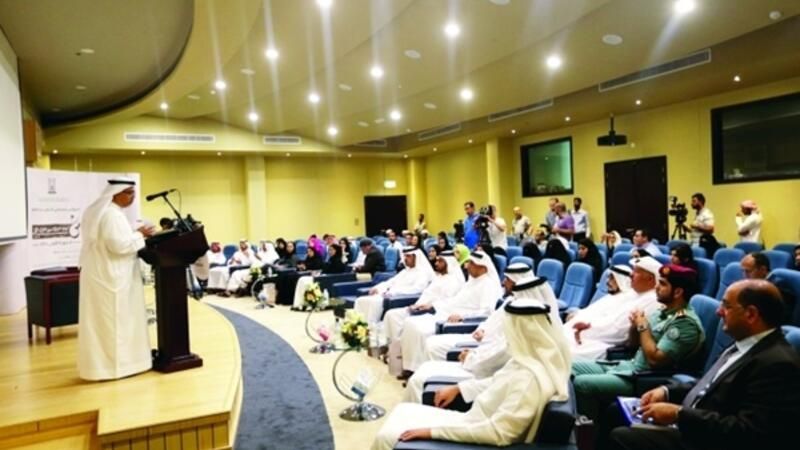
The Sharjah Institute for Heritage launched the Sharjah International Award for Cultural Heritage on Monday, 30 May 2016. The Award comprises three main fields: Best Practices in Safeguarding Elements of Cultural Heritage; Best Narrators and Heritage Bearers (Living Human Treasures); and Best Research and Studies in Cultural Heritage. The Award includes nine prizes with a total value of up to USD 54,000, and aims to contribute to the recognition of successful efforts and to support inspiring initiatives in the field of safeguarding elements of cultural heritage and ensuring their sustainability, in addition to other related objectives. H.E. Abdulaziz Al Musallam, Chairman of the Sharjah Institute for Heritage and Chairman of the Supreme Organizing Committee of the Award, stated during a press conference held on Monday, 30 May 2016 at the Institute’s headquarters, that the Award is launched in line with the vision of His Highness Sheikh Dr. Sultan bin Muhammad Al Qasimi, Supreme Council Member and Ruler of Sharjah, and in implementation of his directives aimed at preserving Arab cultural heritage, promoting the values and methods of safeguarding it, and raising awareness among all segments of society of its importance and the need to ensure its continuity. He added that the Award also reflects the Institute’s belief in the importance of heritage as a key component of national identity and as an effective means of intercultural dialogue, and supports the Institute’s role in expanding interest in cultural heritage and enabling it to achieve its objectives, which include safeguarding elements of cultural heritage, honoring narrators and heritage bearers (Living Human Treasures), and protecting their cultural knowledge in accordance with internationally recognized standards, particularly the conventions issued by the United Nations Educational, Scientific and Cultural Organization (UNESCO). He further noted that the vision of the Award is based on its aspiration to create an enabling environment for the sustainability of Arab cultural heritage and to ensure its transmission to future generations, to promote awareness of humanity’s cultural heritage, and to support cooperation in this field. He emphasized that the Award seeks to recognize distinguished efforts at the local, Arab, and international levels in the safeguarding and documentation of heritage and successful practices aimed at ensuring its continuity, and to promote a spirit of scientific competition—both theoretical and applied—among scholars and practitioners engaged in academic and field research in the preservation and documentation of heritage. He also highlighted that the Award honors Living Human Treasures and underscores the vital role of narrators who transmit oral literary masterpieces, heritage knowledge, and traditional craftsmanship skills in safeguarding humanity’s cultural heritage and ensuring its continuity. For her part, Asma Al Suwaidi, Director of the Award, stated that the Award primarily aims to contribute to the recognition of successful efforts and to support inspiring initiatives at the local, regional, and international levels in the safeguarding of elements of cultural heritage and ensuring their sustainability. It also seeks to strengthen safeguarding practices and to recognize the most outstanding among them in accordance with UNESCO standards, to document safeguarding practices and present them as models of good practice worldwide, to support initiatives that ensure the transmission of cultural heritage from one generation to another, to honor narrators (Living Human Treasures) and highlight their role in transmitting knowledge and expertise, to promote awareness of oral narration techniques and heritage knowledge, and to recognize the best academic and research efforts in the field of intangible cultural heritage. She noted that the Jury Committee comprises a distinguished group of specialists, academics, and researchers in the field of heritage, and explained that the Organizing Committee will hold a number of workshops at the local, Gulf, and international levels to promote the Award and to explain its conditions and significance in the field of heritage. Al Suwaidi confirmed that the Sharjah International Award for Cultural Heritage is an honorary award based on standardized scientific criteria, granted to individuals, groups, or projects. Its main objective is to recognize efforts exerted in safeguarding, protecting, studying, and ensuring the sustainability of cultural heritage through applications in the fields of safeguarding practices, narrators and heritage bearers (Living Human Treasures), and research and studies in cultural heritage. Award Categories In each of the three fields, the Award includes three categories: • Best Practices in Safeguarding Cultural Heritage: Local Practices Award, Arab Practices Award, and International Practices Award. The Award is presented on the occasion of the International Day for Monuments and Sites and within the activities of the Sharjah Heritage Days. • Best Narrators and Heritage Bearers (Living Human Treasures): Local Narrator Award, Arab Narrator Award, and International Narrator Award. The Award is presented during the Sharjah International Narrators Forum. • Best Research and Studies in Cultural Heritage: Local Research Award, Arab Research Award, and International Research Award. The Award is presented during the Sharjah International Heritage Conference. Al Musallam pointed out that the Award is governed by a set of general terms and conditions, foremost of which is that the Sharjah Institute for Heritage is the official organizing body of the Award. Nominees (individuals, groups, or institutions) must be specialists who have made tangible contributions in one of the Award’s fields and categories. Applicants must complete and sign the nomination form (or be represented by an authorized person), and may apply in only one category. The nominated project must comply with the Award’s conditions and criteria, and must not have previously won other awards. Winners commit to granting the Sharjah Institute for Heritage the right to publish, disseminate, and make available the winning work or project, and to dispose of any outputs resulting from the Award by any means deemed appropriate by the Institute. Winners in each category receive a financial prize, the Sharjah Institute for Heritage Shield, and a Certificate of Excellence, while non-winning participants receive Certificates of Participation. Members of the Jury Committee • Aisha Saif Al Khaja, Sharjah Education Council. • Abdulmohsen Sayed Hazin, Al Qasimia University. • Dr. Ahmed Khatabi, University of Sharjah. • Dr. Amina Bou Shahab, Ajman University. • Dr. Fatima Al Sayegh, United Arab Emirates University. • Khadija Ahmed Bamukhrama, Sharjah City for Humanitarian Services.
Address
Sharjah Institute for Heritage, University City, Sharjah, United Arab Emirates.
Contact us
Address
Sharjah Institute for Heritage, University City, Sharjah, United Arab Emirates.
Phone
+97165014999Fax
+97165092606
Email
[email protected]All Rights Reserved – The Award